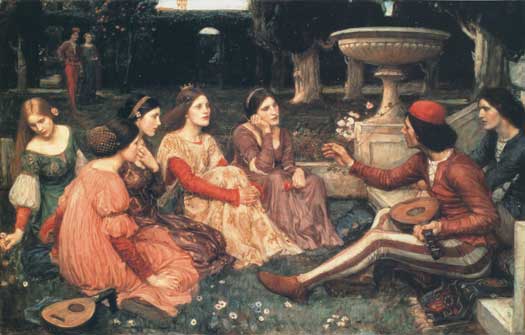
Il Decameron
Quarta Giornata Novella Quarta
Gerbino, contra la fede data dal re Guglielmo suo avolo, combatte una nave del re di Tunisi per torre una sua figliuola, la quale uccisa da quegli che su v'erano, loro uccide, e a lui è poi tagliata la testa.
La Lauretta, finita la sua novella, taceva, e fra la brigata chi con un chi con un altro della sciagura degli amanti si dolea; e chi l'ira della Ninetta biasimava, e chi una cosa e chi altra diceva, quando il re, quasi da profondo pensier tolto, alzò il viso e ad Elissa fe'segno che appresso dicesse, la quale umilmente incominciò.Piacevoli donne, assai son coloro che credono Amor solamente dagli occhi acceso le sue saette mandare, coloro schernendo che tener vogliono che alcuno per udita si possa innamorare; li quali essere ingannati assai manifestamente apparirà in una novella la qual dire intendo. Nella quale non solamente ciò la fama, senza aversi veduto giammai, avere operato vedrete, ma ciascuno a misera morte aver condotto vi fia manifesto.
Guiglielmo secondo re di Cicilia, come i ciciliani vogliono, ebbe due figliuoli, l'uno maschio e chiamato Ruggieri, e l'altro femina, chiamata Gostanza. Il quale Ruggieri, anzi che il padre morendo, lasciò un figliuolo nominato Gerbino; il quale, dal suo avolo con diligenza allevato, divenne bellissimo giovane e famoso in prodezza e in cortesia.
Né solamente dentro a'termini di Cicilia stette la sua fama racchiusa, ma in varie parti del mondo sonando, in Barberia era chiarissima, la quale in que'tempi al re di Cicilia tributaria era. E tra gli altri alli cui orecchi la magnifica fama delle virtù e della cortesia del Gerbin venne, fu ad una figliuola del re di Tunisi, la qual, secondo che ciascun che veduta l'avea ragionava, era una delle più belle creature che mai dalla natura fosse stata formata, e la più costumata e con nobile e grande animo. La quale, volentieri de'valorosi uomini ragionare udendo, con tanta affezione le cose valorosamente operate dal Gerbino da uno e da un altro raccontate raccolse, e sì le piacevano, che essa, seco stessa imaginando come fatto esser dovesse, ferventemente di lui s'innamorò, e più volentieri che d'altro di lui ragionava e chi ne ragionava ascoltava.
D'altra parte era, sì come altrove, in Cicilia pervenuta la grandissima fama della bellezza parimente e del valor di lei, e non senza gran diletto né in vano gli orecchi del Gerbino aveva tocchi; anzi, non meno che di lui la giovane infiammata fosse, lui di lei aveva infiammato.
Per la qual cosa infino a tanto che con onesta cagione dallo avolo d'andare a Tunisi la licenzia impetrasse, disideroso oltre modo di vederla, ad ogni suo amico che là andava imponeva che a suo potere il suo segreto e grande amor facesse, per quel modo che miglior gli paresse, sentire e di lei novelle gli recasse. De'quali alcuno sagacissimamente il fece, gioie da donne portandole, come i mercatanti fanno, a vedere; e interamente l'ardore del Gerbino apertole, lui e le sue cose a'suoi comandamenti offerse apparecchiate. La quale con lieto viso e l'ambasciadore e l'ambasciata ricevette, e rispostogli che ella di pari amore ardeva, una delle sue più care gioie in testimonianza di ciò gli mandò. La quale il Gerbino con tanta allegrezza ricevette, con quanta qualunque cara cosa ricever si possa, e a lei per costui medesimo più volte scrisse e mandò carissimi doni, con lei certi trattati tenendo da doversi, se la fortuna conceduto lo avesse, vedere e toccare.
 Ma andando le cose in questa guisa e un poco più lunghe che bisognato non
sarebbe, ardendo d'una parte la giovane e d'altra il Gerbino, avvenne che il re
di Tunisi la maritò al re di Granata; di che ella fu crucciosa oltre modo,
pensando che non solamente per lunga distanzia al suo amante s'allontanava, ma
che quasi del tutto tolta gli era; e se modo veduto avesse, volentieri, acciò
che questo avvenuto non fosse, fuggita si sarebbe dal padre e venutasene al
Gerbino.
Ma andando le cose in questa guisa e un poco più lunghe che bisognato non
sarebbe, ardendo d'una parte la giovane e d'altra il Gerbino, avvenne che il re
di Tunisi la maritò al re di Granata; di che ella fu crucciosa oltre modo,
pensando che non solamente per lunga distanzia al suo amante s'allontanava, ma
che quasi del tutto tolta gli era; e se modo veduto avesse, volentieri, acciò
che questo avvenuto non fosse, fuggita si sarebbe dal padre e venutasene al
Gerbino.
Similmente il Gerbino, questo maritaggio sentendo, senza misura ne viveva dolente, e seco spesso pensava, se modo veder potesse, di volerla torre per forza, se avvenisse che per mare a marito n'andasse.
Il re di Tunisi, sentendo alcuna cosa di questo amore e del proponimento del Gerbino, e del suo valore e della potenzia dubitando, venendo il tempo che mandar ne la dovea, al re Guiglielmo mandò significando ciò che fare in tendeva, e che, sicurato da lui che né dal Gerbino né da altri per lui in ciò impedito sarebbe, lo 'ntendeva di fa re. Il re Guiglielmo, che vecchio signore era né dello innamoramento del Gerbino aveva alcuna cosa sentita, non imaginandosi che per questo addomandata fosse tal sicurtà, liberamente la concedette e in segno di ciò mandò al re di Tunisi un suo guanto. Il quale, poi che la sicurtà ricevuta ebbe, fece una grandissima e bella nave nel porto di Cartagine apprestare, e fornirla di ciò che bisogno aveva a chi su vi doveva andare, e ornarla e acconciarla per su mandarvi la figliuola in Granata, né altro aspettava che tempo.
La giovane donna, che tutto questo sapeva e vedeva, occultamente un suo servidore mandò a Palermo e imposegli che il bel Gerbino da sua parte salutasse e gli dicesse come ella in fra pochi dì era per andarne in Granata; per che ora si parrebbe se così fosse valente uomo come si diceva e se cotanto l'amasse quanto più volte significato l'avea.
Costui, a cui imposta fu, ottimamente fe'l'ambasciata e a Tunisi ritornossi. Gerbino questo udendo e sappiendo che il re Guiglielmo suo avolo data avea la sicurtà al re di Tunisi, non sapeva che farsi; ma pur, da amor sospinto, avendo le parole della donna intese e per non parer vile, andatosene a Messina, quivi prestamente fece due galee sottili armare, e messivi su di valenti uomini, con esse sopra la Sardigna n'andò, avvisando quindi dovere la nave della donna passare.
Né fu di lungi l'effetto al suo avviso; per ciò che pochi dì quivi fu stato, che la nave con poco vento non guari lontana al luogo dove aspettandola riposto s'era sopravenne. La qual veggendo Gerbino, a'suoi compagni disse:
- Signori, se voi così valorosi siete come io vi tegno, niun di voi senza aver sentito o sentire amore credo che sia, senza il quale, sì come io meco medesimo estimo, niun mortal può alcuna virtù o bene in sé avere; e se innamorati stati siete o sete, leggier cosa vi fia comprendere il mio disio. Io amo, e amor m'indusse a darvi la presente fatica; e ciò che io amo nella nave che qui davanti ne vedete dimora, la quale, insieme con quella cosa che io più disidero, è piena di grandissime ricchezze, le quali, se valorosi uomini siete, con poca fatica, virilmente combattendo, acquistar possiamo. Della qual vittoria io non cerco che in parte mi venga se non una donna, per lo cui amore i'muovo l'arme; ogni altra cosa sia vostra libera mente infin da ora. Andiamo adunque, e bene avventurosa mente assagliamo la nave; Iddio, alla nostra impresa favorevole, senza vento prestarle la ci tien ferma.
Non erano al bel Gerbino tante parole bisogno, per ciò che i messinesi che con lui erano, vaghi della rapina, già con l'animo erano a far quello di che il Gerbino gli confortava con le parole. Per che, fatto un grandissimo romore nella fine del suo parlare che così fosse, le trombe sonarono; e prese l'armi, dierono de'remi in acqua e alla nave pervennero.
Coloro che sopra la nave erano, veggendo di lontan venir le galee, non potendosi partire, s'apprestarono alla difesa.
Il bel Gerbino, a quella pervenuto, fe'comandare che i padroni di quella sopra le galee mandati fossero, se la battaglia non voleano.
I saracini, certificati chi erano e che domandassero, dissero sé essere contro alla fede lor data dal re da loro assaliti; e in segno di ciò mostrarono il guanto del re Guiglielmo e del tutto negaron di mai, se non per battaglia vinti, arrendersi o cosa che sopra la nave fosse lor dare. Gerbino, il qual sopra la poppa della nave veduta aveva la donna troppo più bella assai che egli seco non estimava, infiammato più che prima, al mostrar del guanto rispose che quivi non avea falconi al presente perché guanto v'avesse luogo; e per ciò, ove dar non volesser la donna, a ricever la battaglia s'apprestassero. La qual senza più attendere, a saettare e a gittar pietre l'un verso l'altro fieramente incominciarono, e lungamente con danno di ciascuna delle parti in tal guisa combatterono. Ultimamente, veggendosi Gerbino poco util fare, preso un legnetto che di Sardigna menato aveano, e in quel messo fuoco, con amendue le galee quello accostò alla nave. Il che veggendo i saracini e conoscendo sé di necessità o doversi arrendere o morire, fatto sopra coverta la figliola del re venire, che sotto coverta piagnea, e quella menata alla proda della nave e chiamato il Gerbino, presente agli occhi suoi lei gridante mercé e aiuto svenarono, e in mar gittandola dissono:
- Togli, noi la ti diamo qual noi possiamo e chente la tua fede l'ha meritata.
Gerbino, veggendo la crudeltà di costoro, quasi di morir vago, non curando di saetta né di pietra, alla nave si fece accostare; e quivi su, malgrado di quanti ve n'eran, montato, non altramenti che un leon famelico nell'armento di giuvenchi venuto or questo or quello svenando prima co'denti e con l'unghie la sua ira sazia che la fame, con una spada in mano or questo or quel tagliando de'saracini crudelmente molti n'uccise Gerbino; e, già crescente il fuoco nella accesa nave, fattone a'marinari trarre quello che si potè per appagamento di loro, giù se ne scese con poco lieta vittoria de'suoi avversari avere acquistata.
Quindi, fatto il corpo della bella donna ricoglier di mare, lungamente e con molte lagrime il pianse, e in Cicilia tornandosi, in , piccioletta isola quasi a Trapani dirimpetto, onorevolmente il fe'sepellire, e a casa più doloroso che altro uomo si tornò.
Il re di Tunisi, saputa la novella, suoi ambasciadori di nero vestiti al re Guiglielmo mandò, dogliendosi della fede che gli era stata male osservata, e raccontarono il come. Di che il re Guiglielmo turbato forte, né vedendo via da poter lor giustizia negare (ché la dimandavano), fece prendere il Gerbino; ed egli medesimo, non essendo alcun de'baron suoi che con prieghi da ciò si sforzasse di rimuoverlo, il condannò nella testa e in sua presenzia gliele fece tagliare, volendo avanti senza nepote rimanere che esser tenuto re senza fede.
Adunque così miseramente in pochi giorni i due amanti, senza alcun frutto del loro amore aver sentito, di mala morte morirono, com'io v'ho detto.
El Decamerón
Cuarta Jornada Novela Cuarta
Gerbino, contra la palabra dada al rey Guilielmo, su abuelo, combate una nave del rey de Túnez para quitarle a una hija suya; y matada ésta por los que allí iban, los mata, y a él luego le cortan la cabeza.
Laureta callaba, una vez terminada su novela, y, entre la compañía, quién con uno, quién con otro de la desgracia de los amantes se dolía, y quién reprobaba la ira de Ninetta, y unos una cosa y otros otra decían, cuando el rey, como saliendo de un profundo pensamiento, alzó el rostro y a Elisa le hizo señal de continuar narrando; la cual gentilmente comenzó:
Amables señoras, muchos son los que creen que Amor solamente por las miradas encendido, envía sus saetas, burlándose de quienes sostener quieren que alguien por el oído pueda enamorarse , y que éstos están engañados aparecerá asaz claramente en una novela que contar entiendo, en la que no solamente por la fama, sin haberse visto nunca, veréis que ha obrado sino también cómo a mísera muerte condujo a cada uno os será manifiesto.
Guilielmo II, rey de Sicilia, según dicen los sicilianos, tuvo dos hijos , uno varón llamado Ruggiero, la otra mujer, llamada Constanza. El cual Ruggiero, muriendo antes que su padre, dejó un hijo llamado Gerbino, el cual, con solicitud educado por su abuelo, se hizo un joven hermosísimo y famoso en bizarría y en cortesía.
Y no dentro de los límites de Sicilia se quedó encerrada su fama, sino que en varias partes del mundo sonando, era clarísima en Berbería, que en aquellos tiempos era tributaria del rey de Sicilia. Y entre los demás a cuyos oídos la magnífica fama de la virtud y la cortesía de Gerbino llegaron, hubo una hija del rey de Túnez, la cual, según lo que todos los que la veían decían, era una de las más hermosas criaturas que nunca por la naturaleza hubiera sido formada, y la más cortés y de ánimo grande y noble. La cual, gustando de oír hablar de los hombres valerosos, con tanto afecto retuvo las cosas valerosamente hechas por Gerbino que unos y otros contaban, y tanto le agradaban, que dándole vueltas en su imaginación a cómo debía ser él, ardientemente se enamoró, y con más agrado que de otros hablaba de él y a quien de él hablaba escuchaba.
Por otra parte, había también, como a otros lugares, llegado a Sicilia la grandísima fama de la belleza y del valor de ella, y no sin gran deleite ni en vano había alcanzado los oídos de Gerbino; así, no menos que la joven se había inflamado por él, él por ella se había inflamado.
Por la cual cosa, hasta tanto que con conveniente razón de su abuelo la licencia pidiese para ir a Túnez, deseoso sobremanera de verla, a todo amigo suyo que allí iba, ordenaba que en cuanto estuviera en su poder le comunicase su secreto y gran amor del modo que mejor le pareciese y le trajese de ella noticia. De los cuales, uno lo hizo muy sagazmente llevándole joyas de mujer para que las viese, del modo que hacen los mercaderes, y por completo manifestándole el ardor de Gerbino, él y sus cosas le ofreció dispuestas a sus mandatos; la cual, con alegre rostro el embajador y la embajada recibió; y respondiéndole que ella en igual amor ardía, una de sus más preciosas joyas en testimonio de ello le mandó. La cual recibió Gerbino con tanta alegría como pueda recibirse la cosa más querida, y por aquel mismo muchas veces le escribió y le mandó preciosísimos presentes, haciendo con ella ciertos conciertos para, si la fortuna lo permitiese, verse y tocarse.
Pero andando las cosas de esta guisa y un poco más lejos de lo que hubiera sido necesario ardiendo por una parte la joven y por otra Gerbino, sucedió que el rey de Túnez la casó con el rey de Granada, de lo que ella se afligió sobremanera, pensando que no solamente con larga distancia se alejaba de su amante sino que casi por completo le era arrebatada; y si hubiera habido manera, de buena gana, para que aquello no sucediese, hubiera huido del padre y se hubiera reunido con Gerbino.
Del mismo modo, Gerbino, enterado de este matrimonio, sin medida doliente vivía y pensando si pudiese hallar alguna manera de poder llevársela por la fuerza, si sucediese que por mar fuese al marido.
El rey de Túnez, oyendo algo de este amor y de la determinación de Gerbino, y temiendo su valor y su poder, llegando el tiempo en que debía mandarla, hizo saber al rey Guilielmo lo que quería hacer y que entendía hacerlo si él le aseguraba que ni Gerbino ni otro se lo impediría.
El rey Guilielmo, que viejo era y no había oído nada del enamoramiento de Gerbino, no imaginándose que por ello se le pidiese tal garantía, lo concedió de buena gana y en señal de ello mandó al rey de Túnez su guante . El cual, después de que la seguridad hubo recibido, hizo preparar una grandísima y hermosa nave en el puerto de Cartago y abastecerla con todo lo que fuera necesario, y adornarla y prepararla, para mandar en ella a su hija a Granada; y no esperaba sino el tiempo favorable.
La joven señora, que todo esto sabía y veía, ocultamente mandó a Palermo a un servidor suyo y le ordenó que al bellido Gerbino saludase de su parte y le dijera cómo iba a irse a Granada pocos días después; por lo que ahora se vería si era hombre tan valiente como se decía y si tanto la amaba como muchas veces le había significado.
Aquel a quien le fue ordenada, óptimamente cumplió su embajada y se volvió a Túnez. Gerbino, al oír esto, y sabiendo que el rey Guilielmo su abuelo había otorgado la seguridad al rey de Túnez, no sabía qué hacerse; pero empujado por el amor, habiendo escuchado las palabras de la señora y para no parecer vil, yendo a Mesina, allí hizo prestamente armar dos galeras ligeras, y haciendo subir a ellas valientes hombres, con ellos se fue junto a Cerdeña, pensando que por allí debía pasar la nave de la señora.
Y no tardó en realizarse su pensamiento, porque después de que allí pocos días hubo estado, la nave, con poco viento y no lejana al lugar donde se había apostado esperándola, apareció. Viendo la cual, Gerbino, a sus compañeros dijo:
-Señores, si sois tan valerosos como pienso, ninguno de vosotros creo que esté sin haber sentido o sentir amor, sin el cual, como por mí mismo juzgo, ningún mortal puede ninguna virtud o bien tener en sí; y si enamorados habéis estado o estáis, fácil cosa os será comprender mi deseo. Yo amo: Amor me indujo a daros la presente fatiga, y lo que amo, en la nave que se ve ahí delante está, la cual, junto con la cosa que yo más deseo, va llena de grandísimas riquezas, las cuales, si hombres valerosos sois, con poca fatiga, virilmente combatiendo, podemos conquistar; de cuya victoria no busco quedarme sino con una mujer por cuyo amor muevo las armas; todas las demás cosas sean vuestras libremente desde ahora. Vamos, pues, y con buena ventura asaltemos la nave mientras Dios, favorable a nuestra empresa, sin prestarle viento nos la tiene inmóvil.
No necesitaba el bellido Gerbino tantas palabras porque los mesinenses que con él estaban, deseosos del botín, ya en su ánimo estaban dispuestos a hacer aquello a lo que Gerbino les alentaba con las palabras; por lo que, haciendo un grandísimo alboroto, al final de sus palabras, para que así fuese sonaron las trompetas, y empuñando las armas dieron los remos al agua y a la nave llegaron.
Los que en la nave estaban, viendo de lejos venir las galeras, no pudiéndose ir, se aprestaron a la defensa.
El bellido Gerbino, llegado a ella, ordenó que los patrones a las galeras fuesen llevados si no querían batalla.
Los sarracenos, asegurados de quiénes eran y qué pedían, dijeron que se les asaltaba contra la palabra empeñada con ellos por el rey suyo, y en señal de ello mostraron el guante del rey Guilielmo y del todo se negaron, si no eran vencidos en batalla, a rendirse o a darle nada que hubiera en la nave. Gerbino, que en la popa de la nave había visto a la señora, mucho más hermosa de lo que él ya pensaba, mucho más inflamado en amor que antes, al mostrarle el guante repuso que allí no había en aquel momento halcones para los que se necesitase un guante, y que por ello, si no querían entregarles a la señora, que se preparasen a la batalla. La que, sin esperar más, a arrojarse saetas y piedras el uno contra el otro fieramente comenzaron y largamente con daño de cada una de las partes en tal guisa combatieron.Por último, viéndose Gerbino sin mucho provecho, tomando una barquichuela que de Cerdeña llevado había, y prendiéndole fuego, con las dos galeras la acostó a la nave; lo que viendo los sarracenos y conociendo que por necesidad debían o rendirse o morir, haciendo a cubierta venir a la hija del rey, que bajo cubierta lloraba, y llevándola a la proa de la nave y llamando a Gerbino, ante sus ojos, a ella, que pedía merced y ayuda, le cortaron las venas y arrojándola al mar dijeron:
-Tómala, te la damos como podemos y como tu lealtad la ha merecido.
Gerbino, viendo su crueldad, deseoso de morir, no preocupándose por saetas ni por piedras, a la nave se hizo acercar, y subiendo a ella a pesar de cuantos allí iban, no de otra manera que un león famélico entra en una manada de becerros, ora a éste ora a aquél desangrando y primero con los dientes y con las uñas su ira sacia que el hambre, con una espada en la mano ora a éste ora a aquél cortando de los sarracenos, cruelmente a muchos mató Gerbino ; creciendo ya el fuego en la encendida nave, haciendo a los marineros coger lo que pudieran como recompensa, abajo se fue con aquella poco alegre victoria conseguida sobre sus enemigos.
Luego, haciendo el cuerpo de la hermosa señora recoger del mar, largamente y con muchas lágrimas la lloró, y volviéndose a Sicilia, en Ustica, pequeñísima isla casi enfrente de Trápani, honradamente la hizo sepultar, y a su casa se fue más dolorido que ningún hombre.
El rey de Túnez, conocida la noticia, a sus embajadores de negro vestidos, envió al rey Guilielmo, doliéndose de que la palabra dada mal había sido cumplida, y le contaron cómo. Por lo que el rey Guilielmo, fuertemente airado, no viendo manera de poder negarles la justicia que pedían, hizo apresar a Gerbino, y él mismo, no habiendo ninguno de sus barones que con ruegos se esforzase en disuadirlo, le condenó a muerte y en presencia suya le hizo cortar la cabeza, queriendo antes quedarse sin nieto que tenido por un rey sin honor.
Así, en pocos días, tan miserablemente los dos amantes, sin haber gustado ningún fruto de su amor, de mala muerte murieron, como os he contado.
Giovanni Boccaccio
The Decameron
THE FOURTH DAY, THE FOURTH NOVELL
IN COMMENDATION OF JUSTICE BETWEENE PRINCES; AND DECLARING WITHALL, THAT NEITHER FEARE, DANGERS, NOR DEATH IT SELFE, CAN ANY WAY DAUNT A TRUE AND LOYALL LOVER
Gerbino, contrary to the former plighted faith of his Grand-father, King Gulielmo, fought with a Ship at Sea, belonging to the King of Thunis, to take away his Daughter, who was then in the same Ship. Shee being slaine by them that had the possession of her, he likewise slew them; and afterward had his owne head smitten off.
Madam Lauretta having concluded her Novel, and the company complaining on Lovers misfortunes, some blaming the angry and jealous fury of Ninetta, and every one delivering their severall opinions; the King, as awaking out of a passionate perplexity, exalted his lookes, giving a signe to Madame Elisa, that shee should follow next in order, whereto she obeying, began in this manner. I have heard (Gracious Ladies, quoth she) of many people, who are verily perswaded, that loves arrowes, never wound any body, but onely by the eyes lookes and gazes, mocking and scorning such as maintaine that men may fall in love by hearing onely. Wherein (beleeve me) they are greatly deceived, as will appeare by a Novell which I must now relate unto you, and wherein you shall plainely perceive, that not onely fame or report is as prevailing as sight; but also hath conducted divers, to a wretched and miserable ending of their lives.
Gulielmo the second, King of Sicilie, according as the Sicilian Chronicles record, had two children, the one a sonne, named Don Rogero, and the other a daughter, called Madame Constance. The saide Rogero died before his Father, leaving a sonne behind him, named Gerbino, who, with much care and cost, was brought up by his Grand-father, proving to be a very goodly Prince, and wonderously esteemed for his great valour and humanity. His fame could not containe it selfe, within the bounds or limits of Sicilie onely, but being published very prodigally, in many parts of the world beside, flourished with no meane commendations throughout all Barbarie, which in those dayes was tributary to the King of Sicilie. Among other persons, deserving most to be respected, the renowned vertues, and affability of this gallant Prince Gerbino, was understood by the beautious Daughter to the King of Tunis, who by such as bad seene her, was reputed to be one of the rarest creatures, the best conditioned, and of the truest noble spirit, that ever Nature framed in her very choicest pride of Art.
Of famous, vertuous, and worthy men, it was continually her cheefest delight to heare, and the admired actions of valiant Gerbino, reported to her by many singular discoursers: such as could best describe him, with language answerable to his due deservings, won such honourable entertainment in her understanding soule, that they were most affectionately pleasing to her, and in recapitulating (over and over againe) his manifold and heroycall perfections; meere speech made her extreamely amorous of him, nor willingly would she lend an eare to any other discourse, but that which tended to his honour and advancement.
On the other side, the fame of her incomparable beauty, with addition of her other infinite singularities beside; as the World had given eare to innumberlesse places, so Sicilie came at length acquainted therewith, in such flowing manner, as was truly answerable to her merit. Nor seemed this as a bare babling rumour, in the Princely hearing of royall Gerbino; but was embraced with such a reall apprehension, and the entire probation of a true understanding: that he was no lesse enflamed with noble affection towards her, then she expressed the like in vertuous opinion of him. Wherefore, awaiting such convenient opportunity, when he might entreat license of his Grand-father, for his owne going to Thunis, under colour of some honourable occasion, for the earnest desire he had to see her: he gave charge to some of his especiall friends (whose affaires required their presence in those parts) to let the Princesse understand, in such secret manner as best they could devise, what noble affection he bare unto her, devoting himselfe onely to her service.
One of his chosen friends thus put in trust, being a jeweller, a man of singular discretion, and often resorting to Ladies for sight of his jewels, winning like admittance to the Princesse: related at large unto her, the honourable affection of Gerbino, with full tender of his person to her service, and that she onely was to dispose of him. Both the message and the messenger, were most graciously welcome to her, and flaming in the selfe-same affection towards him: as a testimony thereof, one of the very choisest Jewels which she bought of him, she sent by him to the Prince Gerbino, it being received by him with such joy and contentment, as nothing in the world could be more pleasing to him. So that afterward, by the trusty carriage of this Jeweller, many Letters and Love-tokens passed betweene them, each being as highly pleased with this poore, yet happy kind of entercourse, as if they had seene and conversed with one another.
Matters proceeding on in this manner, and continuing longer then their love-sick passions easily could permit, yet neither being able to finde out any other meanes of helpe; it fortuned that the King of Thunis promised his daughter in marriage to the King of Granada, whereat she grew exceedingly sorrowfull, perceiving, that not onely she should be sent further off, by a large distance of way from her friend, but also be deprived utterly, of all hope ever to enjoy him. And if she could have devised any meanes, either by secret flight from her Father, or any way else to further her intention, she would have adventured it for the Princes sake. Gerbino in like maner bearing of this purposed marriage, lived in a hell of torments, consulting oftentimes with his soule, how he might be possessed of her by power, when she should be sent by Sea to her husband, or private stealing her away from her Fathers Court before: with these and infinite other thoughts, was he incessantly afflicted, both day and night.
By some unhappy accident or other, the King of Thunis heard of this their secret love, as also of Gerbinoes purposed policy to surprize her, and how likely he was to effect it, in regard of his manly valour, and store of stout friends to assist him. Hereupon, when the time was come, that he would convey his daughter thence to her marriage, and fearing to be prevented by Gerbino: he sent to the King of Sicilie, to let him understand his determination, craving safe conduct from him, without impeachment of Gerbino, or any one else, untill such time as his intent was accomplished. King Gulielmo being aged, and never acquainted with the affectiotiate proceedings of Gerbino, nor any doubtfull reason to urge this security from him, in a case convenient to be granted: yeelded the sooner thereto right willingly, and as a signall of his honourable meaning, he sent him his royall Glove, with a full confirmation for his safe conduct.
No sooner were these Princely assurances received, but a goodly ship was prepared in the Port of Carthagena, well furnished with all thinges thereto belonging, for the sending his daughter to the King of Granada, waiting for nothing else but best favouring windes. The young Princesse, who understood and saw all this great preparation; secretly sent a servant of hers to Palermo, giving him especiall charge, on her behalfe, to salute the Prince Gerbino, and to tell him that (within few dayes) she must be transported to Granada. And now opportunity gave faire and free meanes, to let the world know, whether he were a man of that magnanimous spirit, or no, as generall opinion had formerly conceived of him, and whether he affected her so firmely, as by many close messages he had assured her. He who had the charge of this embassie, effectually performed it, and then returned backe to Thunis.
The Prince Gerbino, having heard this message from his divine Mistresse, and knowing also, that the Kin his Grandfather, had past his safe conduct to the King of Thunis, for peaceable passage through his Seas: was at his wits end, in this urgent necessity, what might best bee done. Notwithstanding, moved by the setled constancy of his plighted Love, and the speeches delivered to him by the messenger from the Princesse: to shew himselfe a man endued with courage, he departed thence unto Messina, where he made ready two speedy gallies, and fitting them with men of valiant disposition, set away to Sardignia, as making full account, that the Ship which carried the Princesse, must come along that Coast. Nor was his expectation therein deceived: for, within few dayes after, the Ship (not over-swiftly winded) come sailing neere to the place where they attended for her arrivall; whereof Gerbino had no sooner gotten a sight, but to animate the resolutes which were in his company, thus he spake.
Gentlemen, if you be those men of valour, as heretofore you have bene reputed, I am perswaded, that there are some among you, who either formerly have, or now instantly do feele, the all-commanding power of Love, without which (as I thinke) there is not any mortall man, that can have any goodnesse—or vertue dwelling in him. Wherefore, if ever you have bene amorously affected, or presently have any apprehension thereof, you shall the more easily Judge of what I now aime at. True it is, that I do love, and love hath guided me to be comforted, and manfully assisted by you, because in yonder Ship, which you see commeth on so gently under saile (even as if she offered her selfe to be our prize) not onely is the Jewell which I most esteeme, but also mighty and unvalewable treasure, to be wonne without any difficult labour, or hazard of a dangerous fight, you being men of such undauntable courage. In the honour of which victory, I covet not any part or parcell, but onely a Ladie, for whose sake I have undertaken these Armes, and freely give you all the rest contained in the Ship. Let us set on them, Gentlemen, and my deerest friends; couragiously let us assaile the ship, you see how the wind favours us, and (questionlesse) in so good an action, Fortune will not faile us.
Gerbino needed not to have spoken so much, in perswading them to seize so rich a booty, because the men of Messina were naturally addicted to spoile and rapine: and before the Prince began his Oration, they had concluded to make the ship their purchase. Wherefore, giving a lowde shout, according to their Country manner, and commanding their Trumpets to sound chearfully, they rowed on a maine with their Oares, and (in meere despight) set upon the ship. But before the Gallies could come neere her, they that had the charge and managing of her, perceyving with what speede they made towards them, and no likely meanes of escaping from them, resolvedly they stood upon their best defence, for now it was no time to be slothfull. The Prince being come neere to the Ship, commanded that the Patrones should come to him, except they would adventure the fight. When the Sarazines were thereof advertised, and understood also what he demanded, they returned answer: That their motion and proceeding in this manner, was both against Law and plighted faith, which was promised by the King of Sicilie, for their safe passage through the Sea by no meanes to be mollested or assailed. In testimony whereof, they shewed his Glove, avouching moreover, that neither by force (or otherwise) they would yeelde, or deliver him any thing which they had aboorde their Ship.
Gerbino espying his gracious Mistresse on the Ships decke, and she appearing to be farre more beautifull then Fame had made relation of her: being much more enflamed now, then formerly he had bin, replyed thus when they shewed the Glove. We have (quoth he) no Faulcon here now, to be humbled at the sight of your Glove: and therefore, if you will not deliver the Lady, prepare your selves for fight, for we must have her whether you will or no. Hereupon, they began to let flie (on both sides) their Darts and arrowes, with stones sent in violent sort from their slings, thus continuing the fight a long while, to very great harme on either side. At the length, Gerbino perceiving, that small benefit would redound to him, if he did not undertake some other kinde of course: he tooke a small Pinnace, which purposely he brought with him from Sardignia, and setting it on a flaming fire, conveyed it (by the Gallies help) close to the ship. The Sarazines much amazed thereat, and evidently perceiving, that either they must yeeld or dye; brought their Kings daughter to the prow of the ship, most greevously weeping and wringing her hands. Then calling Gerbino, to let him behold their resolution, there they slew hir before his face, and afterward, throwing her body into the Sea, saide: Take her, there we give her to thee, according to our bounden duty, and as thy perjury hath justly deserved.
This sight was not a little greevous to the Prince Gerbino, who madded now with this their monstrous cruelty, and not caring what became of his owne life, having lost her for whom he onely desired to live: not dreading their Darts, Arrowes, slinged stones, or what violence els they could use against him; he leapt aboord their ship, in despight of all that durst resist him, behaving himselfe there like a hunger-starved Lyon, when he enters among a heard of beasts, tearing their carkasses in pieces both with his teeth and pawes. Such was the extreme fury of this poore Prince, not sparing the life of any one, that durst appeare in his presence; so that what with the bloody slaughter, and violence of the fires encreasing in the Ship; the Mariners got such wealth as possibly they could save, and suffering the Sea to swallow the rest, Gerbino returned unto his Gallies againe, nothing proud of this so ill-gotten victory.
Afterward, having recovered the Princesse dead body out of the Sea, and enbalmed it with sighes and teares: he returned backe into Sicilie, where he caused it to be most honourably buried, in a little Island, named Ustica, face to face confronting Trapanum. The King of Thunis hearing these disastrous Newes, sent his Ambassadors (habited in sad mourning) to the aged King of Sicilie, complaining of his faith broken with him, and how the accident had falne out. Age being sodainly incited to anger, and the King extreamly offended at this injury, seeing no way whereby to deny him justice, it being urged so instantly by the Ambassadors: caused Gerbino to be apprehended, and he himselfe (in regard that none of his Lords and Barons would therein assist him, but laboured to divert him by their earnest importunity) pronounced the sentence of death on the Prince, and commanded to have him beheaded in his presence; affecting rather, to dye without an heire, then to be thought a King voyde of justice. So these two unfortunate Lovers, never enjoyed the very least benefite of their long wished desires: ended both their lives in violent manner.